Overview
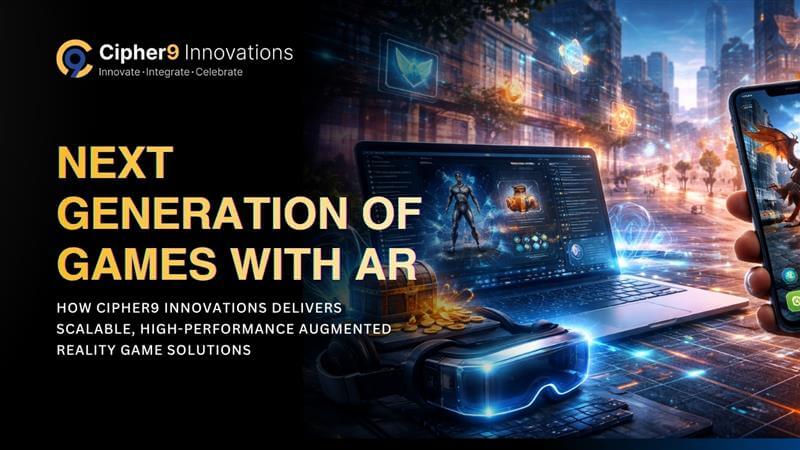
The gaming industry is entering a new era where digital experiences are no longer confined to screens. Augmented reality (AR) is transforming how users interact with games by merging virtual elements with the real world. From interactive storytelling to location-based gameplay, AR is redefining engagement, immersion, and monetization.
For businesses and startups, investing in AR game development services is no longer experimental—it’s a strategic move toward future-ready gaming ecosystems. At Cipher9 Innovations, we help businesses build scalable, immersive, and high-performance AR games tailored for modern users.
What Is AR Game Development?
Augmented reality game development involves creating games that overlay digital content onto real-world environments using smartphones, tablets, or AR headsets. Unlike traditional games, AR games enable players to interact with virtual objects within their physical surroundings.
Key features of AR games include:
- Real-time environment tracking
- Surface and object detection
- Interactive 3D elements
- Spatial audio integration
- Location-based gameplay
This combination creates a dynamic and immersive gaming experience that blends reality with digital interaction.
Why AR Gaming Is Growing Rapidly
The rapid rise of AR gaming is driven by advancements in technology and changing user expectations.
1. Advanced Mobile Hardware
Modern smartphones are equipped with powerful processors, cameras, and sensors that support real-time AR rendering, making AR gaming more accessible than ever.
2. AR Development Frameworks
Tools like ARKit and ARCore simplify development by providing built-in tracking, motion sensing, and environmental understanding.
3. Rise of Spatial Computing
New devices such as mixed reality headsets are expanding the scope of AR gaming beyond mobile screens into immersive environments.
4. Demand for Interactive Experiences
Users now prefer games that are interactive, social, and immersive—qualities that AR delivers exceptionally well.
Types of AR Games
Understanding different AR game formats helps businesses choose the right development strategy.
1. Location-Based AR Games
These games use GPS and mapping systems to create real-world exploration experiences. Players physically move to different locations to unlock content or rewards.
2. Marker-Based AR Games
Triggered by QR codes or images, these games display digital content when a marker is detected. They are often used in marketing and educational campaigns.
3. Markerless AR Games
Using environmental tracking, these games place objects on real-world surfaces without markers, offering more immersive gameplay.
4. Multiplayer AR Games
These games allow multiple users to interact within the same augmented environment, requiring real-time synchronization and backend infrastructure.
AR Game Development Process
Building a successful AR game requires a structured and strategic development approach.
1. Concept & Game Design
This phase defines the game idea, mechanics, and how AR enhances gameplay. It includes:
- Target audience analysis
- Gameplay flow design
- Monetization strategy
2. AR Experience Design
Developers design how virtual objects interact with real-world environments, ensuring seamless integration.
3. Development & Integration
This phase involves:
- Integrating AR frameworks
- Developing gameplay features
- Building UI/UX components
- Implementing backend systems
4. Testing & Optimization
AR games are tested across various environments, lighting conditions, and devices to ensure consistent performance.
5. Deployment & Scaling
After launch, games are continuously updated with new features, events, and improvements to enhance user retention.
Technologies Used in AR Game Development
A successful AR game relies on a combination of technologies:
Game Engines
- Unity
- Unreal Engine
These engines handle rendering, physics, and gameplay mechanics.
AR Frameworks
- ARKit (iOS)
- ARCore (Android)
- WebAR
These frameworks enable environment tracking and object placement.
Backend Infrastructure
Cloud systems support:
- Multiplayer functionality
- Data storage
- Analytics
- Real-time updates
AR Gaming Market Insights
The AR gaming market is experiencing exponential growth. With increasing adoption across industries, AR is becoming a core component of digital engagement strategies.
Key trends include:
- Rapid adoption of immersive gaming experiences
- Integration of AR in marketing and branding
- Growth of mobile-first AR platforms
- Expansion into enterprise and education sectors
Businesses that invest early in AR game development gain a competitive edge in a fast-evolving market.
Cost to Develop an AR Game
The cost of AR game development varies based on several factors:
Key Cost Drivers
- Game complexity and features
- Platform (iOS, Android, WebAR)
- Multiplayer functionality
- 3D asset creation
- Backend infrastructure
Estimated Cost Range
- Basic AR Game: $15,000 – $40,000
- Mid-Level AR Game: $40,000 – $100,000
- Advanced AR Game: $100,000+
Choosing the right development partner ensures optimal cost efficiency and high-quality output.
Why Businesses Invest in AR Game Development Services
1. Enhanced User Engagement
AR games provide immersive experiences that keep users engaged for longer durations.
2. Innovative Marketing Opportunities
Brands use AR games for interactive campaigns, product promotions, and customer engagement.
3. New Revenue Streams
Monetization options include:
- In-app purchases
- Subscription models
- Virtual goods
- Brand partnerships
4. Competitive Advantage
Early adoption of AR positions businesses as innovators in the gaming and tech space.
The Future of AR Gaming
The future of AR gaming is driven by continuous innovation and technological evolution.
Spatial Computing
Games will move beyond screens into real-world environments, offering deeper immersion.
AI Integration
Artificial intelligence will enable adaptive gameplay, smarter NPCs, and personalized experiences.
Web-Based AR
WebAR will eliminate the need for downloads, making AR games more accessible.
Persistent AR Worlds
Future AR games will feature shared environments that evolve over time, creating digital ecosystems.
Cross-Platform Experiences
Integration with VR and traditional gaming will lead to hybrid gaming ecosystems.
Why Choose Cipher9 Innovations for AR Game Development?
At Cipher9 Innovations, we specialize in delivering next-generation AR game development services tailored to your business goals.
Our Expertise Includes:
- Custom AR game development
- Unity & Unreal-based solutions
- Multiplayer AR infrastructure
- Scalable backend systems
- AI-powered gameplay integration
We focus on building immersive, scalable, and high-performance AR games that drive engagement and business growth.
Conclusion
Augmented reality is transforming the gaming landscape by bridging the gap between digital and physical worlds. As technology evolves, AR gaming will become more immersive, interactive, and widely adopted.
Businesses looking to stay ahead must invest in AR game development services to create innovative gaming experiences that captivate users and unlock new revenue opportunities.
With the right strategy and technology partner like Cipher9 Innovations, you can turn your AR gaming vision into a powerful, future-ready product.