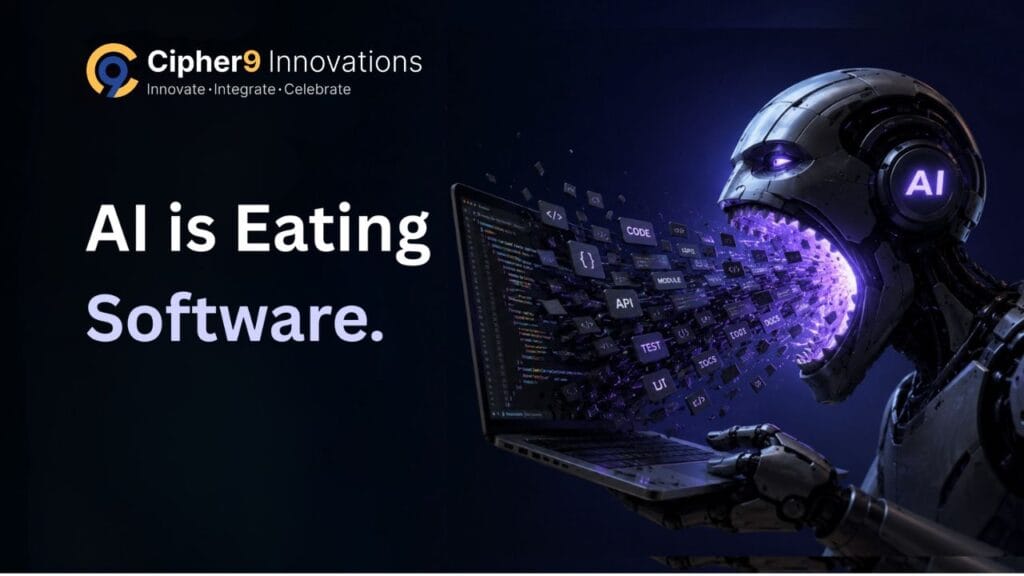
For decades, software development followed a predictable process: gather requirements, write code, test, deploy, and maintain. Today, Artificial Intelligence is reshaping that entire workflow.
AI isn’t replacing software developers. It’s changing how software is built.
AI is no longer just a feature inside software—it’s becoming the engine behind how software is built.
Developers can now use AI to generate code, identify bugs, create documentation, automate testing, and even suggest improvements to existing systems. Tasks that once took days can often be completed in hours, helping teams move faster and focus on innovation rather than repetitive work.
But the impact of AI goes far beyond development teams.
Businesses are using AI to automate operations, improve customer experiences, analyze large volumes of data, and make smarter decisions. From intelligent chatbots and predictive analytics to personalized recommendations and workflow automation, AI is becoming a competitive advantage across industries.
This shift doesn’t mean software developers are becoming obsolete. Instead, their role is evolving. The most successful teams are those that combine human creativity, strategic thinking, and problem-solving with the speed and efficiency of AI.
The future of software development isn’t about humans versus AI—it’s about humans working alongside AI to build smarter, faster, and more scalable solutions.
Conclusion
AI is no longer a futuristic concept—it’s already transforming how software is developed and how businesses operate.
At Cipher9, we help organizations leverage AI-driven technologies to build secure, scalable, and future-ready digital solutions.
The question is no longer whether AI is changing software.
The question is: Is your business ready for the change?